
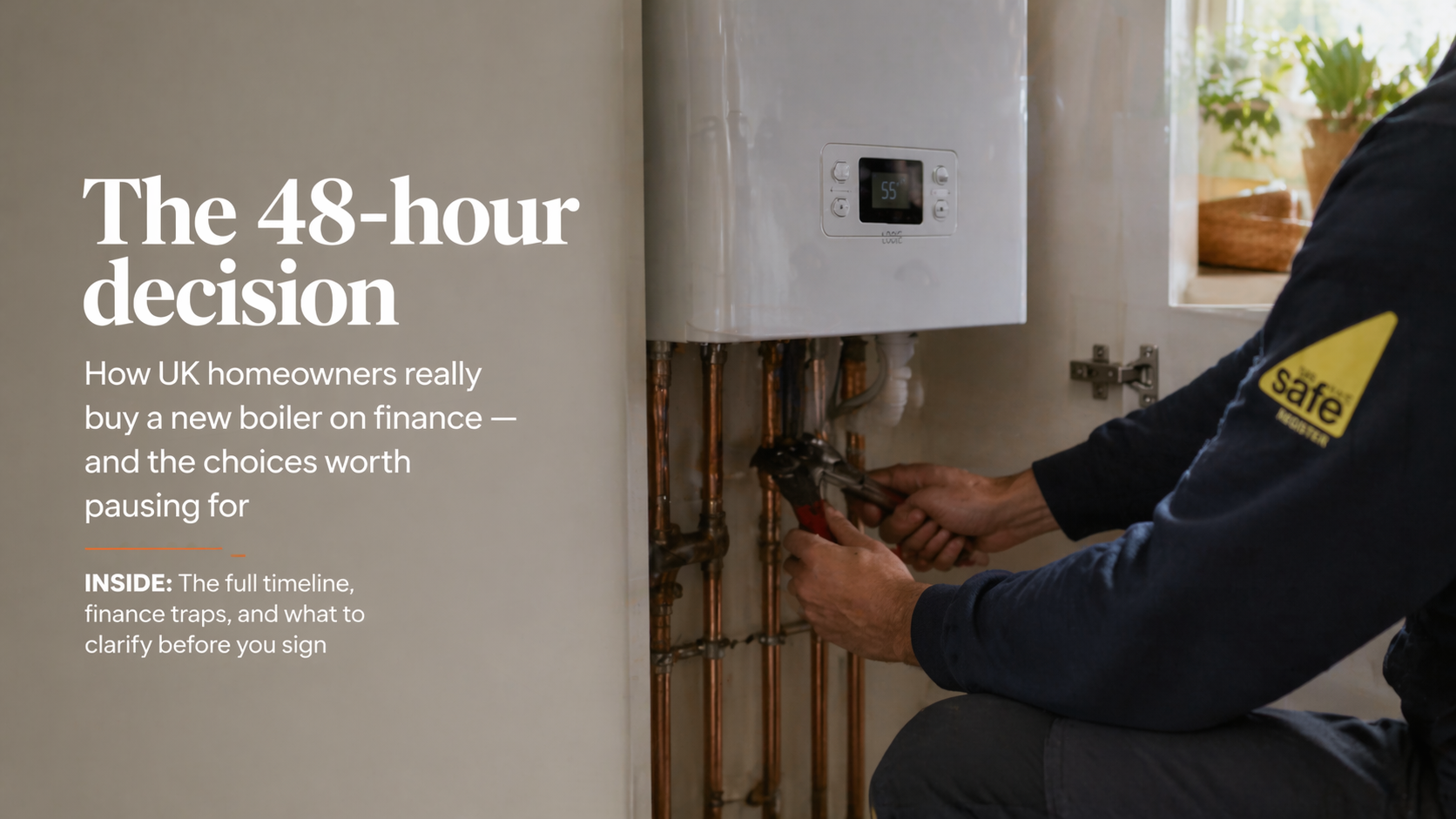
Most UK homeowners don’t buy a new boiler until their current one gives up — and by then, they’ve got three to five days to make a decision that will cost them £2,000 to £4,000 and stay in their utility cupboard for the next decade. Finance makes that decision easier, but only if you understand what you’re agreeing to before you click through the installer’s quote flow.
See Heatable review, Heatable vs iHeat and best boiler installers UK before you sign.
This guide walks through the actual process of getting a new boiler on finance in the UK: how long it takes, what paperwork you’ll need, what happens on installation day, and the choices worth making carefully rather than clicking through.
The full timeline, from quote to first payment
Most online installers advertise “next-day installation.” That’s genuinely possible, but it compresses every decision into a few hours. Here’s what the full process actually looks like when it goes smoothly.
-
Online quote and initial soft search
You fill in a property questionnaire (number of bedrooms, bathrooms, current boiler type, flue location), the installer returns a fixed price for one or more boiler options, and a soft credit search shows your likely APR without affecting your credit file.
-
Choose your boiler and finance term
This is where the money is won or lost. APR, deposit, term length, and model tier all interact. The default option presented is rarely the cheapest total cost — it’s usually the lowest monthly payment, which stretches the term.
-
Hard credit application
The installer passes your details to their finance partner (usually Novuna, V12, or Omni Capital) for a formal credit check. Most decisions are returned in under a minute. You sign the credit agreement electronically at this stage.
-
Installation booking
Major online installers offer next-day installation for straightforward combi swaps. More complex jobs (system conversions, moving the boiler location, power flushes required) typically mean a 3 to 10 day wait. You’ll receive a confirmed time slot, not just a date.
-
Installation day
A Gas Safe registered engineer arrives, removes the old boiler, fits the new one, performs a system flush if quoted, commissions the boiler, and walks you through the controls. You’ll be asked to sign a Benchmark commissioning certificate — keep this for your warranty records.
-
First payment, then the warranty period begins
Your first direct debit leaves your account about a month after the installation date. The manufacturer’s warranty (typically 7 to 12 years) is activated by the engineer’s registration submission — confirm this has happened within a fortnight.
What you’ll actually need to apply
The credit application itself is quick, but it only goes quickly if you’ve got the documents to hand. Missing paperwork is the most common reason applications get deferred for a second review rather than approved instantly.
- Proof of identity — passport or driving licence
- Proof of address covering the last three years (if you’ve moved recently)
- Employment status and gross annual income
- Your bank’s sort code and account number for the direct debit mandate
- Your existing boiler’s make and model, if you know it
- Details of where the boiler is currently located and where the flue exits the property
Fixed price versus “from” price — the distinction that catches people out
Online installers advertise fixed-price boilers. Local and national engineers (British Gas, local Gas Safe firms) typically advertise “from” prices, with a home survey required before a final figure is given.
- Price quoted online is the price you pay, guaranteed
- No home survey required for standard installations
- Finance application integrated into the quote flow
- Next-day installation commonly available
- Limited customisation — you pick from preset options
- Any genuine complications uncovered on the day may add cost, but quoted cases are honoured
- “From” price online, with a surveyor visit to confirm
- Final price can differ meaningfully from the online figure
- More flexibility for complex jobs — conversions, relocations
- Typically 1 to 3 weeks between enquiry and installation
- Finance arranged separately after the surveyed quote is accepted
- Better for older properties or unusual setups where a desk quote would miss details
For a straightforward combi swap in a standard home, the fixed-price route is usually cheaper and faster. For anything unusual — moving the boiler to a loft, converting from a regular boiler to a combi, an older property with microbore pipework — the surveyed route protects you from nasty surprises, even if the price is higher.
Getting the finance term right
Term length is the single biggest driver of how much your new boiler actually costs you. Most installers present three to five term options on their quote page, and the choice isn’t obvious if you’re seeing it for the first time on a stressful day with no heating.
| Term | Typical APR | Monthly on £2,500 | Total cost | Best for |
|---|---|---|---|---|
| 24 months | 0% | £104 | £2,500 | Most homeowners who can afford the monthly |
| 48 months | 0% | £52 | £2,500 | Budget-tight but credit is good |
| 60 months | 10.9% | £54 | £3,270 | Rarely — check 48m 0% instead |
| 120 months | 11.9% | £36 | £4,340 | Last resort only |
Illustrative figures on a £2,500 financed balance with no deposit.
The 48-month 0% option is the one most people miss. It’s almost identical in monthly cost to a 60-month interest-bearing plan, but saves you £770 in total.
For a deeper breakdown of installer-specific APRs and total-cost calculations, see our full guide to UK boiler finance.
Things worth clarifying before you sign
The credit agreement is a legally binding document. The installation contract is a separate document. Both are worth reading before signing, but a few specific details catch people out:
What’s included in the quoted price
Boiler, flue, standard controls, and Gas Safe commissioning are universal. What varies between installers: a system power flush (sometimes £300 to £600 extra if not included), magnetic filter (£80 to £150), smart thermostat upgrade, extended warranty registration, and any pipework upgrades required. Ask for an itemised breakdown rather than a lump sum.
What happens if the installer finds unexpected issues on the day
Legitimate additional costs exist — badly corroded pipework, asbestos in the flue run, an incompatible gas supply. Reputable installers phone you before starting the extra work, give a fixed price for the additional job, and give you the option to defer or reschedule. Confirm this policy in writing before installation day.
Early settlement terms
If you come into money and want to clear the finance early, most FCA-regulated agreements allow this without penalty. Confirm your specific agreement does. Early settlement on an interest-bearing plan stops further interest accruing from the settlement date — genuinely worthwhile if your financial situation changes.
What happens if the boiler fails during the warranty period
The manufacturer’s warranty is with the manufacturer (Worcester Bosch, Ideal, Vaillant etc.), not the installer. Warranty claims go through the manufacturer’s engineer network. The installation warranty, covering workmanship, is typically 12 months and sits with the installer. Know which is which.
Finance versus paying in full — the decision grid
- You don’t have £2,500+ in accessible savings, or you’d drain your emergency fund to cover it
- You qualify for 0% APR and a term you can comfortably afford
- Your current boiler has failed and you can’t wait weeks to save up
- Your credit score is good enough to secure the installer’s lowest tier
- You have the savings comfortably and wouldn’t need to replenish them quickly
- Your credit profile only qualifies you for interest-bearing finance at 10%+ APR
- Your current boiler still works, so you’ve got time to save rather than borrow
- You’d rather not add another direct debit to your monthly commitments
Frequently asked questions
With a fixed-price online installer, as little as 24 hours. Next-day installation is genuinely available for straightforward combi swaps when credit is approved quickly. Surveyed quotes from British Gas or local engineers typically take 1 to 3 weeks from enquiry to fitting.
Generally no. The boiler becomes a fixture of the property, and finance agreements assume you own the asset being financed. Private tenants may be eligible for ECO4 if they have their landlord’s written consent — which is a grant, not finance. Speak to your landlord first; in most tenancies, the boiler is their responsibility to replace.
No. You’re always free to pay in full and arrange your own finance separately — a personal loan from your bank, for instance, or a 0% purchase credit card. The installer’s integrated finance is convenient, but it’s one option among several. For good-credit applicants, a bank personal loan sometimes beats the installer’s APR.
Most major installers offer £0-deposit finance, including Heatable and British Gas. Quote Heatable and iHeat and compare the deposit on each offer. A larger deposit isn’t required, but it typically unlocks better APR tiers. Some lenders reserve their 0% APR offers for applicants putting 20% or 25% down. If you can afford a deposit, it’s usually worth paying one.
The initial soft-search quote has no impact. The hard search when you commit to the agreement leaves a visible mark for two years and can reduce your score by a few points short-term. If you’re declined, avoid applying to multiple installers in quick succession — multiple hard searches in a short window compound the score impact.
Yes, most installers bundle these into the financed total when you add them at the quote stage. Adding them after installation usually means a separate transaction. Worth thinking through at the quote stage rather than agreeing to upsells on the day itself.
HomeBoiler provides independent information to help UK homeowners understand their heating and finance options. We are not a qualified installer, a regulated financial adviser, or an agent of any installer or lender mentioned in this article. Always confirm finance terms directly with the provider, verify any installer’s Gas Safe registration at gassaferegister.co.uk before work begins, and consider speaking to a regulated financial adviser if you’re uncertain which borrowing option suits your circumstances. Rates and offers mentioned reflect our understanding at time of writing and are subject to change.