
Boiler Finance with Bad Credit: What’s Actually Available (UK)
Poor credit doesn’t rule you out of boiler finance in the UK — it just changes the APR you’ll be offered and the lenders willing to work with you. A score of 560 can still get you a financed boiler; it’ll just cost you roughly £700 more over a 5-year term than the same boiler financed at prime rates. Whether that’s worth it, and how to get the best deal available to you, depends on details most comparison sites don’t explain.
Widest credit acceptance of the two. Soft-search first so a decline does not hit your file.
Get a Heatable quote →Useful second quote if Heatable is a no. 0% is usually 24 months and needs a stronger file.
Get an iHeat quote →Read the full Heatable review, the Heatable vs iHeat comparison, and best boiler installers UK before you apply.
This guide breaks down which credit tier you’re actually in, what APR ranges to expect at each level, which UK installers work with subprime lenders, and the alternative routes that often beat boiler finance outright when your credit is poor.
What counts as “bad credit” in the UK
The UK has three main credit reference agencies — Experian, Equifax, and TransUnion — and each uses its own scoring scale. Lenders don’t all use the same one either. So “my credit score is 620” means different things depending on which app you checked.
Rather than fixating on one number, most lenders group applicants into broad tiers based on the overall picture: your score, recent credit events (CCJs, defaults, missed payments), debt-to-income ratio, and address stability. Boiler finance decisions land in roughly the following tiers.
These tiers are approximate. A “good” score with a recent unpaid default will be treated closer to “poor” than “fair” by most lenders — recency and severity of credit events weigh heavily alongside the headline number.
What bad-credit boiler finance actually costs
The APR differential between prime and subprime finance adds up quickly, particularly on the longer terms that subprime applicants are often steered toward. Here’s the real-money impact on a £2,500 boiler.
| Credit tier | Typical APR | Term | Monthly | Total cost | Extra paid vs prime |
|---|---|---|---|---|---|
| Excellent | 0% | 48 months | £52 | £2,500 | — |
| Good | 10.9% | 60 months | £54 | £3,240 | £740 |
| Fair | 15% | 60 months | £59 | £3,570 | £1,070 |
| Poor | 24% | 60 months | £72 | £4,315 | £1,815 |
Illustrative. Actual APRs vary by individual credit profile, lender, and current market conditions.
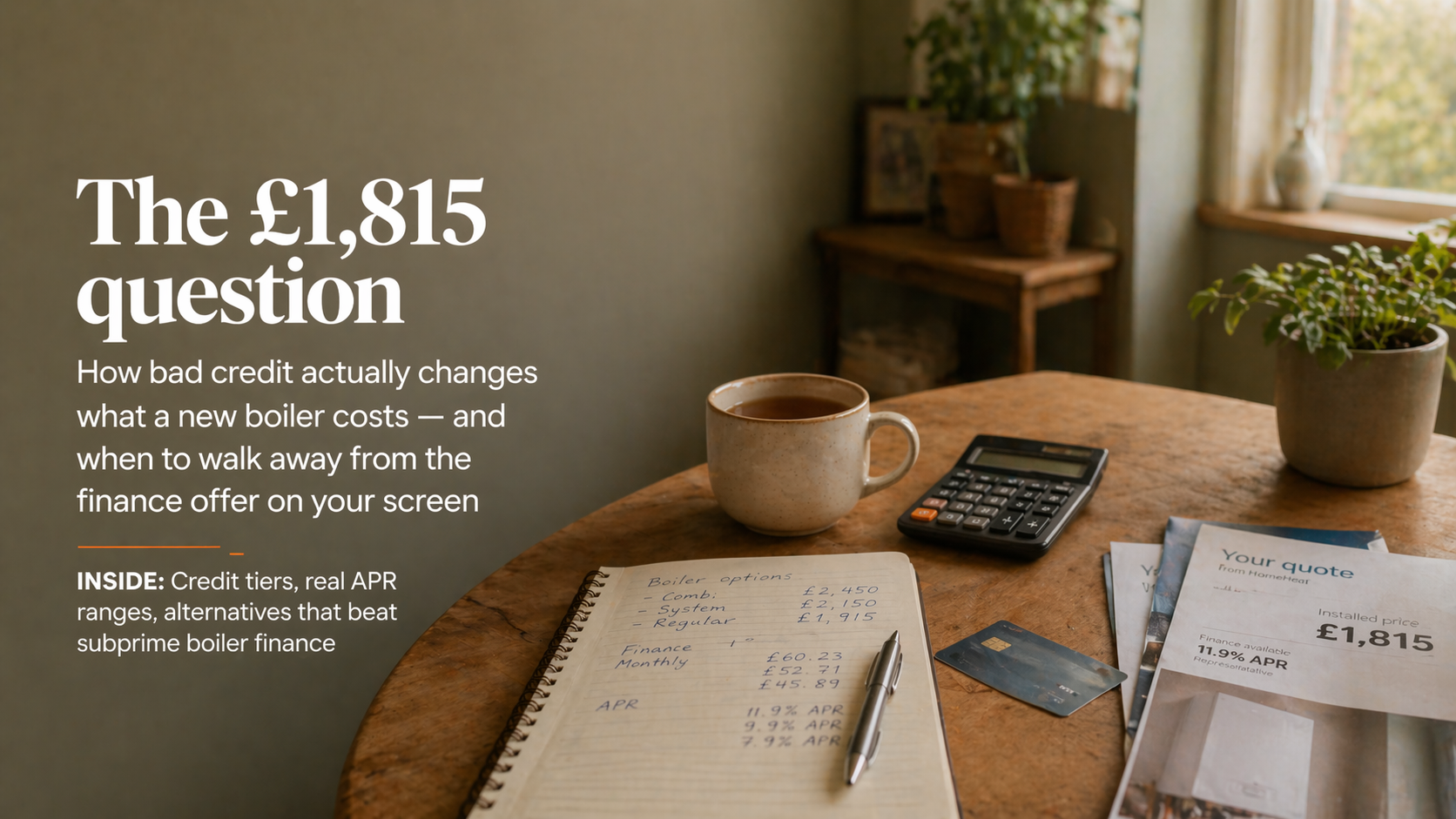
On a £2,500 boiler, the difference between prime and subprime finance is roughly a second boiler — £1,815 over 5 years at 24% APR.
That’s not an argument against getting a boiler on finance if you need one. A working boiler in winter is worth more than £1,815 of interest over 5 years. It’s an argument for checking whether any of the cheaper alternatives work for you first, before accepting a subprime boiler finance offer as your only option.
Which UK installers work with bad-credit applicants
Not every installer’s finance partner accepts subprime applicants. Some only lend to prime and near-prime borrowers, which is why applications from fair-credit profiles can be declined at one installer and approved at another with essentially identical terms.
Installers most likely to approve fair-to-poor credit
iHeat is the second quote. Soft-search first. 0% is usually 24 months and needs a stronger file than Heatable’s 48-month 0%.
Heatable explicitly states they work with both prime and subprime lenders. Their tool typically returns offers for a wider range of profiles than single-lender installers. Deposit requirements may kick in at the lower credit tiers.
Warmzilla similarly partners with multiple lenders and has accepted fair-credit applications at competitive APRs — though 0% APR at this tier is unusual.
Installers with tighter credit requirements
British Gas tends to approve a narrower credit band. Applications below the “good” tier are more often declined or deferred for manual review.
Local Gas Safe installers without integrated finance tools often arrange finance through a single retail lender (V12 or Novuna typically), which can mean a harder yes/no than a multi-lender online installer.
The practical approach: run soft searches with Heatable first and iHeat second. Both return an immediate indication of whether you’ll be approved and at what rate, without any credit-file footprint. You learn where you stand in 20 minutes.
Cheaper alternatives to check first
If you’re in the fair-to-poor credit tier, there are usually better options than subprime boiler finance. Worth checking in this order:
- ECO4 eligibility. If you claim Universal Credit, Pension Credit, Income Support, or several other qualifying benefits, you may be entitled to a free replacement boiler. It’s a grant, not a loan — no credit involvement.
- Credit union loan. Rate-capped at 42.6% APR by law, typically lending at 12–25% even to members with poor credit. Often materially cheaper than subprime boiler finance.
- Guarantor personal loan. If a family member with good credit is willing to co-sign, APRs drop to around 15%. Use it to pay the installer in cash.
- 0% purchase credit card. If you’re on the “fair” boundary rather than deep subprime, you may still qualify for a 0% purchase card with a 12–18 month promotional period.
- Local council boiler grants. Several councils run their own schemes supplementing ECO4. Worth a search of your authority’s website.
For a full breakdown of what’s available when credit is the blocker, see our guide to pay-monthly boilers when credit checks are a concern.
Rebuilding credit before applying
If your boiler is still working and the replacement is planned rather than urgent, even 3 to 6 months of credit-building can move you up a tier and cut your APR meaningfully. The standard levers:
Register on the electoral roll
Being on the electoral register at your current address is one of the fastest credit-score improvements available. If you’ve recently moved and haven’t updated, this alone can add 20 to 50 points within a month or two.
Open and use a credit-builder card responsibly
A credit-builder card with a low limit, used for small regular purchases and paid off in full every month, builds a positive repayment history. Effects show up within 3 to 6 months of consistent use.
Check your credit file for errors
All three UK credit reference agencies let you see your file free of charge — Experian via its own app, Equifax and TransUnion via Clearscore and Credit Karma respectively. Look for accounts that aren’t yours, defaults from paid-off debts that weren’t updated, or addresses you’ve never lived at. Corrections are free and can shift your score quickly.
Reduce your credit utilisation
Using more than 30% of your available credit limit pulls your score down. Paying down existing balances before applying for new finance can lift your score several tiers in a single month — particularly effective if you’re close to the threshold between “fair” and “good”.
Don’t apply for multiple credit products in quick succession
Each hard search leaves a mark visible to other lenders for two years. A cluster of applications in a few weeks suggests financial distress and makes subsequent lenders more cautious. Soft-search quotes don’t count — only formal applications.
What to avoid entirely
The bad-credit boiler finance space attracts a fair amount of predatory advertising. A few signals that an offer isn’t worth your time:
- APRs above 30%. Some unregulated “rent-to-own” boiler schemes work out at effective APRs of 40% to 50% once totalled up. Walk away.
- “Guaranteed approval” language. Illegal under FCA rules. Any lender using it is either misrepresenting its product or operating unregulated.
- Upfront “application fees” or “processing charges” before you’ve received a credit decision. Legitimate UK consumer finance doesn’t charge to apply.
- Any lender you can’t find on the FCA register at register.fca.org.uk. Unregulated lending gives you no Financial Ombudsman recourse.
- Doorstep assessors pushing finance applications on the same visit. High-pressure sales are a regulatory red flag; reputable installers quote online or leave time for you to decide.
Frequently asked questions
There’s no single threshold, but broadly: above 800 gets you any offer including headline 0% APR; 670–799 qualifies for most mainstream options; 560–669 means you’ll typically pay 12–18% APR; below 560 puts you into subprime territory where APRs start around 20%. These bands are approximate and lenders weigh recent credit events alongside the headline number.
Yes, though the default’s age matters significantly. A default over six years old has dropped off your credit file and doesn’t affect new applications. A default settled within the last three years is still visible but treated more leniently than an unpaid one. An active, unpaid default typically restricts you to subprime lenders only.
No. Soft searches aren’t visible to other lenders and don’t affect your score. You can run soft-search quotes with multiple installers and lenders without any credit-file impact. Only the hard search at the final application stage leaves a visible mark.
If your boiler still works, usually yes. Moving from “fair” to “good” tier over 6 months can save £700 or more in interest on a 5-year plan. If your boiler has already failed and you’re facing a winter without heating, waiting isn’t a real option — in that case, ECO4 or a credit union loan are your best non-subprime routes.
Yes. Lenders assess creditworthiness (likelihood you’ll repay) as well as affordability (whether you can afford to). A poor credit history can result in a decline even on a modest monthly payment, because the lender views the default risk as too high regardless of current income.
Yes, significantly. A deposit of 20% or more reduces the lender’s exposure and often unlocks a better APR tier than you’d otherwise qualify for. It can also flip a borderline application from declined to approved. If you’re in the fair or poor tier and have some savings, putting down a deposit is usually worth the short-term hit to cash.