
This article contains affiliate links. We may earn a commission if you buy through our links, at no extra cost to you. Last reviewed: August 2026.
A combi boiler (short for “combination boiler”) is a single compact gas-fired unit that produces both your central heating and your hot water on demand, without needing a separate hot water cylinder or a cold water storage tank. It is the most common type of boiler in UK homes today, fitted in approximately 80% of new installations, and the default choice for most homes with 1-2 bathrooms.
The “combination” refers to the two jobs a combi boiler does in one unit: it heats your radiators when the heating is on, and it produces hot water instantly when you turn a tap or shower on. Older boiler types (system boilers, regular boilers) needed a separate hot water cylinder in the airing cupboard and sometimes a cold water tank in the loft. A combi removes all of that, freeing up loft and cupboard space and simplifying the system.
 ★★★★★
4.8 from 14,000+ reviews
★★★★★
4.8 from 10,000+ reviews
★★★★★
4.8 from 14,000+ reviews
★★★★★
4.8 from 10,000+ reviews
Combi boiler: the short answer
A single gas-fired unit that does both jobs: heats your radiators and produces hot water on demand. No cylinder, no loft tank, no waiting for hot water to heat up. The most common boiler type in UK homes today, suitable for most 1-2 bathroom properties. Modern combi boilers are A-rated for efficiency (90-94%), come in outputs from 24kW to 50kW, and qualify for warranties up to 12 years.
How a combi boiler works
A combi boiler has two operating modes, and only does one at a time:
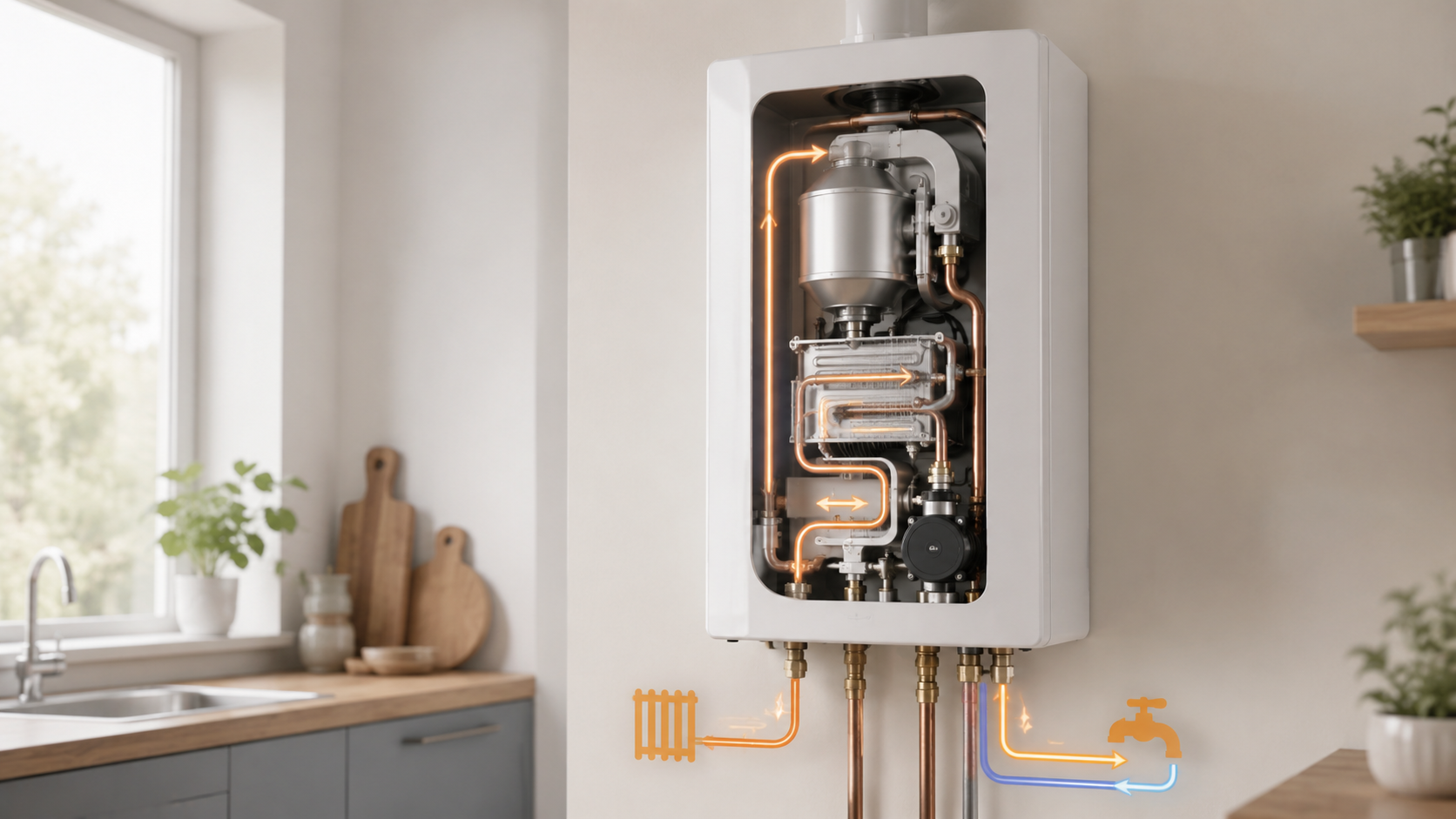
Heating mode. When your thermostat calls for heat, the boiler fires gas through its burner, heating water that circulates around your radiators via a pump. The hot water passes through the heat exchanger (the most important component inside the boiler), transfers its heat to the radiators, and returns to the boiler to be reheated. The combi keeps doing this until the thermostat is satisfied.
This is a closed-loop circuit: the same water circulates around your radiators continuously, never mixing with the water that comes out of your taps. The radiator circuit operates at low pressure (typically 1.0-1.5 bar) and contains chemical inhibitor to prevent corrosion.
Hot water mode. When you turn on a hot tap or shower, the combi senses the flow and instantly switches modes. The heating circuit pauses (the radiators temporarily stop being heated). Instead, the boiler heats cold mains water as it passes through a second heat exchanger (called the “plate heat exchanger” on most models). This produces continuous hot water for as long as the tap is running, with no storage tank required.
When you turn the tap off, the boiler switches back to heating mode. The whole process takes seconds and is usually invisible to the user, although you may occasionally notice the radiators going cold for a minute or two during a long shower.
How combi boilers differ from other boiler types
The UK has three main types of gas boiler. Understanding the differences is the foundation of choosing the right type for your home.
| Combi boiler | System boiler | Regular (conventional) boiler | |
|---|---|---|---|
| Hot water cylinder? | No | Yes (heated by boiler) | Yes (heated by boiler) |
| Cold water tank in loft? | No | No | Yes |
| Hot water delivery | On demand | From cylinder | From cylinder |
| Multiple simultaneous taps? | Limited (one bathroom) | Yes | Yes |
| Best for | 1-2 bathroom homes | 3-4+ bathroom homes | Older homes with existing system |
| Space requirement | Minimal (boiler only) | Boiler + cylinder | Boiler + cylinder + loft tank |
| Installation cost | £1,800-£3,500 fitted | £2,500-£4,500 fitted | £2,200-£4,000 fitted |
| Share of new UK installs | ~80% | ~15% | ~5% |
For most modern UK homes, a combi is the default and correct choice. System boilers make sense for larger homes with 3+ bathrooms in regular simultaneous use, or for homes with very low mains water pressure where a combi cannot deliver adequate shower flow rates. Regular boilers are mostly a legacy choice now: useful when replacing an existing regular boiler without ripping out the loft tank, but rarely the right new install.
Is a combi boiler right for your home?
Combi boilers suit the majority of UK homes but not all. Five practical considerations help you decide.
Bathroom count
One bathroom: combi is almost always the right answer. Two bathrooms: combi works if a high-output unit (32-40kW) is fitted, particularly if the bathrooms are not typically used simultaneously. Three or more bathrooms in regular simultaneous use: a system boiler with a hot water cylinder is usually the better choice because it can deliver multiple high-flow taps at once. A 40kW combi can technically handle three simultaneous outlets, but flow rate to each suffers and shower experience degrades meaningfully.
Mains water pressure
Combi boilers depend on adequate mains water pressure (ideally 1.0 bar or above at the boiler inlet). In areas with poor mains pressure (some rural locations, top-floor flats, older urban properties with narrow lead supply pipes), a combi can struggle to deliver acceptable shower flow rates. Both Heatable and iHeat will ask about your mains pressure during the quote process and will flag potential issues.
If you have measured mains pressure below 1.0 bar at the kitchen tap, a system boiler with a stored hot water cylinder is usually the better choice. Worth measuring before committing; a basic pressure gauge that screws onto an outside tap costs about £15 from any plumbing merchant.
Available space
Combi boilers are compact, typically wall-mounted in a kitchen cupboard or utility room, with dimensions around 740mm tall, 400mm wide, and 280-340mm deep. They free up the airing cupboard previously used for a hot water cylinder, which is one of the main reasons UK homes convert from system or regular boilers to combi during refurbishments.
Existing system type
Switching from a system or regular boiler to a combi (called a “conversion”) costs more than a like-for-like swap because pipework, the cylinder, and sometimes the loft tank all need removing. Conversion installs typically run £2,800-£4,500 fitted, versus £1,800-£3,000 for a like-for-like combi swap. Worth weighing this cost against the long-term benefits (space saved, simplified system, modern efficiency).
Energy efficiency
All modern UK boilers must be condensing (A-rated for efficiency, 90-94%), and combi boilers slightly edge out system boilers on real-world efficiency because they don’t waste energy keeping a cylinder of hot water warm when no one is using it. For homes that use heating intermittently or have variable hot water demand, this can save 5-10% on annual gas bills compared to a system boiler.
Get a fixed-price combi boiler quote in 60-90 seconds
Heatable and iHeat both show real fitted combi boiler prices for your specific home in under 2 minutes. Quote Heatable first for 48-month 0%. Quote iHeat for a second number, or next-day if you order by 3pm. The quote tool asks about your existing setup, mains pressure, bathroom count and boiler location, then shows real installed prices. No obligation, no follow-up sales calls, no home survey before quoting.
- Online quote in ~90 seconds
- Broader credit acceptance via panel lenders
- Save My Quote for later comparison
- 4.8 stars from 14,000+ Trustpilot reviews
- Online quote in ~60 seconds
- Next working day if you order by 3pm
- Also fits Viessmann, Alpha and Glow-worm
- 4.8 stars from 10,000+ Trustpilot reviews
What size combi boiler do you need?
Combi boiler output is measured in kilowatts (kW), and the rating typically refers to the maximum hot water output rather than the central heating output (which is usually lower). UK combi boilers come in outputs from 24kW to around 50kW.
| Output | Best for | Approximate hot water flow rate |
|---|---|---|
| 24-25kW | 1-bed flats, small terraces | 10-11 L/min |
| 28-30kW | 2-3 bed semi-detached, single bathroom | 11-13 L/min |
| 32-35kW | 3-4 bed homes, 1 bathroom plus en-suite | 13-15 L/min |
| 40kW+ | 4+ bed homes with two bathrooms in regular use | 16-19 L/min |
The most common UK combi boiler output is 30kW, which suits the majority of 2-3 bedroom semi-detached homes with one bathroom. Going significantly larger than your actual demand wastes money on capacity you never use, but also wastes energy through inefficient “short-cycling” where an oversized boiler repeatedly fires and stops because it can heat the system faster than it loses heat.
Going significantly smaller than your demand leads to cold showers, slow radiator heat-up times, and a boiler that runs at maximum output constantly, shortening its lifespan. The right size is the one that matches your actual peak demand.
Combi boiler pros and cons
Where combi boilers win
- Unlimited hot water on demand (you can shower for as long as you want)
- Compact single-unit install, no cylinder or loft tank required
- Frees up the airing cupboard previously used for a cylinder
- Highest efficiency in the UK boiler market (90-94% A-rated)
- Lower fitted cost than system or regular boilers (£1,800-£3,500 vs £2,500-£4,500)
- Simpler heating system, fewer components to fail
- Better suited to modern UK home patterns (smaller properties, fewer bathrooms)
- Most boiler brands now focus their R&D on combi development
Where combi boilers struggle
- Can only handle one hot tap at a time without flow rate dropping
- Dependent on adequate mains water pressure (1.0+ bar at the boiler inlet)
- 3+ bathroom homes with simultaneous use need a system boiler instead
- Switching from system or regular to combi (conversion) costs £1,000-£1,500 more than like-for-like
- Limited compatibility with solar thermal panels for hot water heating
- Hot water “deadleg” loss between boiler and tap can be wasteful in larger homes
The main UK combi boiler brands
Five brands dominate the UK combi market. Each has reviewed individual models on our site:
- Worcester Bosch: the most trusted UK boiler brand with the densest engineer service network. The Greenstar range runs from the entry Greenstar 1000 to the premium 8000+. Stainless steel heat exchangers across the range; warranties up to 12 years with Worcester Accredited install.
- Vaillant: German engineering with the longest no-conditions warranty (12 years standard on the ecoTEC Plus) and deepest modulation in the market. Strongest pick for buyers using third-party smart thermostats thanks to full OpenTherm support.
- Ideal: British-made at Hull, Yorkshire. The best value-per-pound UK boilers with strong warranties at lower prices than Worcester or Vaillant. The Vogue MAX competes credibly at the premium tier.
- Baxi: the other British manufacturer (Preston, since 1866). Stainless steel heat exchangers at value prices. The 800 range is the standout for value buyers.
- Navien: Korean value challenger with strong hot water flow at competitive prices. Good fit for high-demand homes that can’t quite justify a system boiler.
For a ranked comparison across all five brands and an editorial pick in each price tier, see our best combi boiler UK guide.
How a combi boiler gets installed
A typical like-for-like combi swap (replacing an existing combi with a new one in the same location) takes 4-7 hours and is completed by a single Gas Safe-registered engineer. The process:
- Power down and drain. The engineer isolates gas and water supplies, then drains the heating system to remove the old boiler safely.
- Remove old boiler. Disconnect pipework, remove flue, and detach the old unit. Modern boilers weigh 30-50kg so this is a one-person job.
- Mount and connect new boiler. Fix the new boiler to the wall, connect gas, mains water, heating flow and return pipes, condensate drain, and flue. Pipework adjustments may be needed if the new boiler has different pipe centres than the old one.
- System flush. Run a chemical flush through the radiator circuit to remove sludge that has built up over years. Skipping this step shortens the new boiler’s life by years.
- Fit system filter. Install a magnetic system filter (e.g. Adey Magnaclean, Worcester Greenstar System Filter, or equivalent) to catch future sludge. Required for the extended manufacturer warranty on most brands.
- Commission and test. Power up the boiler, set initial pressure (1.0-1.5 bar), bleed radiators, run heating and hot water modes, check flue gas analysis with a calibrated meter, and confirm everything is working safely.
- Register and document. Issue the Gas Safe certificate of compliance and register the boiler with the manufacturer to activate the warranty within 30 days.
Conversions (system to combi, regular to combi) take longer (typically a full day) because the existing hot water cylinder, loft tank and associated pipework all need removing. Quote Heatable first for 48-month 0%. Quote iHeat for a second number, or next-day if you order by 3pm. For a full breakdown of Heatable’s pricing, finance options and installation process, see our Heatable review.
Common combi boiler questions
How long does a combi boiler last?
A well-maintained UK combi boiler typically lasts 12-15 years, with premium brands (Worcester, Vaillant) routinely reaching 15-18 years and budget brands averaging 10-13 years. The biggest factor is annual servicing combined with a fitted system filter. See our how long do boilers last guide for full lifespan data by brand.
Can a combi boiler run two showers at once?
Technically yes, but performance suffers meaningfully. A 30kW combi running two showers at once will deliver roughly half its rated flow rate to each shower, often producing a frustrating drizzle rather than a proper shower. A 40kW combi handles this better but still drops below ideal. For homes where two showers are regularly used simultaneously, a system boiler with a hot water cylinder is genuinely the better choice.
Are combi boilers more efficient than system boilers?
Slightly. All modern UK boilers must be A-rated condensing (90-94% efficient), but combi boilers don’t waste energy keeping a cylinder of hot water warm when no one is using it, which gives them a 5-10% real-world advantage in homes with intermittent hot water demand. For homes that use hot water heavily throughout the day, the difference narrows.
Do combi boilers need a hot water cylinder?
No, that is the entire point of a combi. The boiler produces hot water on demand directly from the mains, with no storage tank required. This is the main reason combis have become the dominant UK boiler type since the early 2000s: removing the cylinder frees up the airing cupboard.
Do combi boilers work in cold weather?
Yes, all modern UK combi boilers are designed to operate reliably in UK winter conditions. The most common winter-specific issue is the external condensate pipe freezing during sub-zero spells, which causes the boiler to lock out with an error code. Properly insulating the condensate pipe at install (or retrofitting insulation) prevents this. Most modern boilers also include an anti-freeze function that automatically fires the burner if internal temperature drops below 5°C.
What’s the difference between a combi and a system boiler?
A combi heats your radiators and produces hot water on demand from a single unit, with no storage. A system boiler heats your radiators and heats a separate hot water cylinder, which stores hot water for later use. System boilers handle multiple simultaneous outlets better but require space for the cylinder and have slightly higher running costs because the cylinder loses heat when not in use.
Can I have underfloor heating with a combi boiler?
Yes, with caveats. Combi boilers can run underfloor heating zones using a heat exchanger or low-loss header to manage the lower flow temperatures underfloor heating needs (typically 35-45°C versus 60-80°C for radiators). Best implemented at install rather than retrofitted. For homes with extensive underfloor heating across multiple zones, a system boiler is often the better choice.
Should you choose a combi boiler?
For around 80% of UK homes, yes. If you live in a 1-3 bedroom property with one bathroom (or one bathroom plus an en-suite), have adequate mains water pressure, and are happy to give up the airing cupboard space a hot water cylinder occupies, a combi is almost certainly the right boiler type for you.
If you live in a 4+ bedroom home with two or more bathrooms in regular simultaneous use, or have poor mains water pressure, a system boiler with a hot water cylinder is usually the better choice. For homes replacing an existing combi like-for-like, sticking with a combi is almost always the simplest and cheapest decision.
For a ranked breakdown of the best combi boilers available in the UK in 2026, see our best combi boiler UK guide. For the practical decision of what size and brand suits your specific home, the easiest path is a fixed-price online quote from Heatable or iHeat (under 2 minutes, no obligation). Quote Heatable first.
Get a fixed-price combi boiler quote online
Heatable and iHeat both show real fitted prices for combi boilers across all major UK brands in under 2 minutes. Quote Heatable first for 48-month 0%. Quote iHeat for a second number, or next-day if you order by 3pm. The quote tool determines the right output and brand for your specific home based on bathroom count, mains pressure, and existing setup.
- Online quote in ~90 seconds
- Broader credit acceptance via panel lenders
- Save My Quote for later comparison
- 4.8 stars from 14,000+ Trustpilot reviews
- Online quote in ~60 seconds
- Next working day if you order by 3pm
- Also fits Viessmann, Alpha and Glow-worm
- 4.8 stars from 10,000+ Trustpilot reviews
This guide was last updated in August 2026. We are not a credit broker, lender or installer. Heatable and iHeat handle quoting, finance and installation directly.