
This article contains affiliate links. We may earn a commission if you buy through our links, at no extra cost to you. Last reviewed: August 2026.
Repressurising a boiler means letting more cold mains water into your central heating system to bring the pressure back up to its normal working level, usually 1.0 to 1.5 bar. It is one of the most common boiler problems UK homeowners face, and for most modern combi boilers it is a genuine two-minute DIY fix that needs no tools and no engineer call-out. If your heating or hot water has stopped working and the pressure gauge on the front of your boiler is reading below 1 bar, this is almost certainly the cause.
This guide walks through the exact steps for the three filling systems used on UK boilers (external filling loop, internal filling key, and keyless filling lever), covers the brand-specific differences for Worcester Bosch, Vaillant, Ideal and Baxi, and explains the one safety rule that matters most. It also covers what to do if you overfill, and the important point that repressurising fixes the symptom, not the cause: if your boiler keeps losing pressure, you have a leak that needs finding.
 ★★★★★
4.8 from 14,000+ reviews
★★★★★
4.8 from 10,000+ reviews
★★★★★
4.8 from 14,000+ reviews
★★★★★
4.8 from 10,000+ reviews
How to repressurise a boiler: the short answer
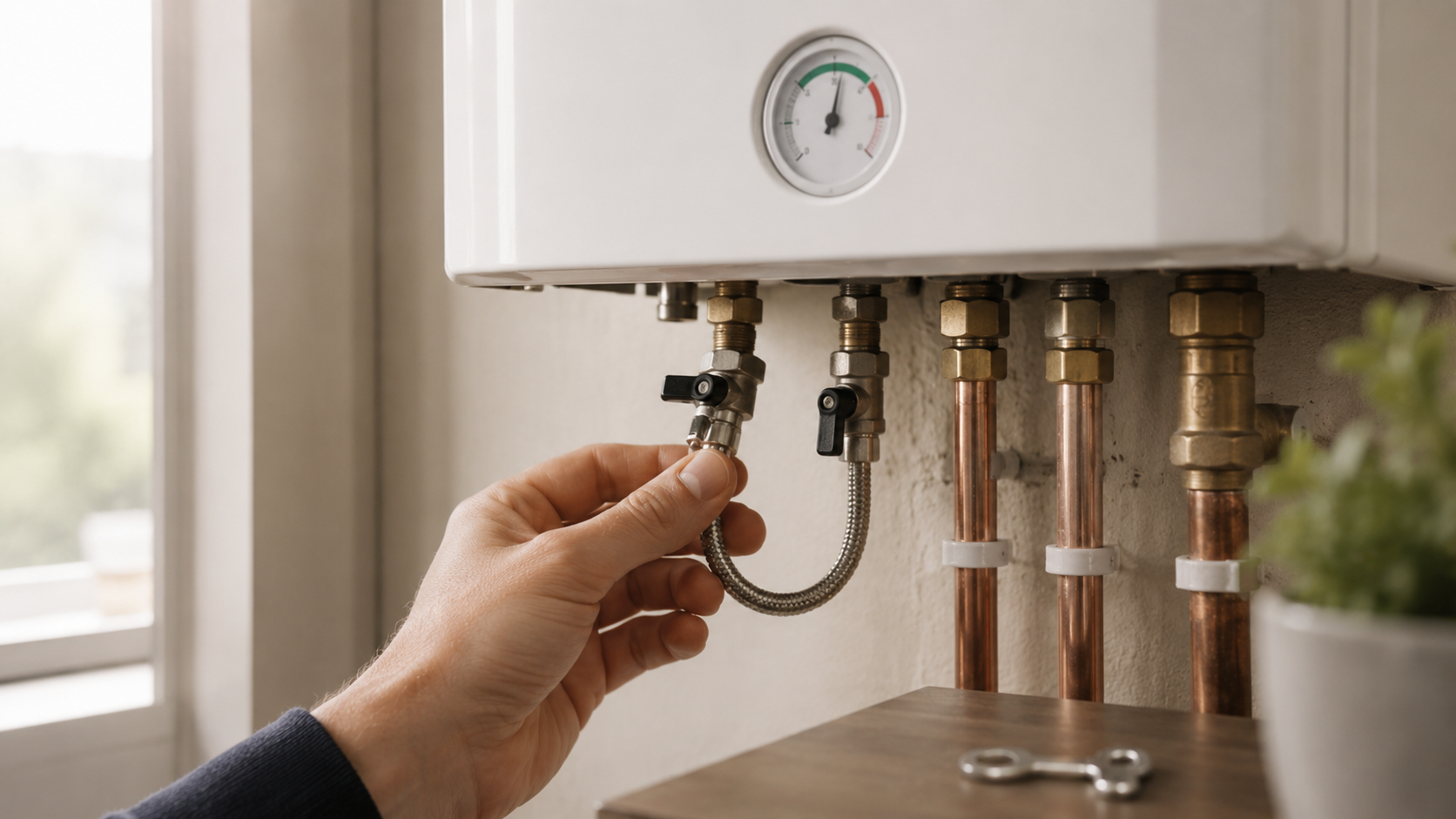
Switch off the boiler and let it cool. Find the filling loop (a silver braided hose under the boiler, or an internal key or lever). Slowly open both valves to let cold mains water into the system, watching the pressure gauge. Close the valves the moment the gauge reaches 1.0 to 1.5 bar. Switch the boiler back on and reset it if needed. If you used an external loop, disconnect it afterwards. The whole job takes around two minutes.
When does a boiler need repressurising?
A combi boiler runs as a sealed, pressurised system. When the pressure inside that system drops too low, the boiler shuts itself down as a safety measure and stops producing heating and hot water. Three signs point to low pressure as the cause:
- The pressure gauge reads below 1 bar. Check the gauge on the front of the boiler, which will be either a round hydraulic dial or a digital display. Healthy pressure sits between 1.0 and 1.5 bar when the system is cold. Anything below 1 bar (often shown in a red zone on a dial) means the boiler needs topping up.
- Heating or hot water has stopped working. A boiler that has locked out on low pressure typically gives you no heating and no hot water at all, or fires briefly then cuts out.
- A low-pressure fault code is showing. Most modern boilers display a specific code when pressure is too low, such as F1 on many Ideal boilers, F.22 on Vaillant, or E118 on Baxi. The brand table further down lists the common ones.
Pressure naturally drifts down a little over months as tiny amounts of air work out of the system, so an occasional top-up once or twice a year is normal. Needing to repressurise every few days or weeks is not normal and points to a leak, which we cover at the end of this guide.
Before you start
Three quick checks make the job safer and stop you wasting water:
- Turn the boiler off and let it cool. Never work on a hot system. Switch the boiler off at its control and give it time to cool down before touching any valves.
- Check your radiator bleed valves are fully closed. If a radiator or towel rail bleed valve has been left even slightly open, the system will keep losing the water you put in. Close them all before you start.
- Identify which filling system your boiler has. There are three types, and the method differs slightly for each. Look underneath the boiler casing. An external filling loop is a flexible silver braided hose with a valve at each end. An internal filling key is a small plastic key that slots into a port on the underside. A keyless filling lever is a small blue or coloured lever built into the pipework. If you are not sure, your boiler manual will tell you, and most are available free on the manufacturer’s website.
How to repressurise a boiler with an external filling loop
This is the most common system on modern UK combi boilers. The filling loop is a flexible silver braided hose, usually sitting underneath the boiler, with a small valve (often black) at each end connecting it to the mains and to the heating circuit.
- Switch off the boiler and let it cool if you have not already.
- Check the loop is securely attached at both ends. The braided hose should be firmly connected to both valves, with no water leaking around the connections.
- Open the first valve. Turn it slowly so it lines up with the direction of the pipe. Nothing will happen yet on its own.
- Open the second valve slowly. You should now hear cold mains water flowing into the system. Open it gently rather than all at once.
- Watch the pressure gauge climb. Keep your eye on the gauge as the needle or digital reading rises.
- Close both valves at 1.0 to 1.5 bar. The moment the gauge reaches the correct level, close the second valve and then the first. Topping up usually takes only about ten seconds of water flow, so do not walk away.
- Switch the boiler back on and press the reset button if the display still shows a fault code.
- Disconnect the external loop. Undo both ends, catch any drips with a small cloth or bowl, and store the loop somewhere safe.
How to repressurise a boiler with a filling key
Some boilers, including many Worcester Bosch models, use an internal keyed filling link instead of a braided hose. The key is a small plastic piece that slots into a port on the underside of the boiler. Older combi boilers sometimes use a similar key arrangement.
- Switch off the boiler and let it cool.
- Line up the key. Align the arrow on the key with the open padlock symbol on the port, then push the key fully into the slot.
- Lock the key in place. Turn it to the closed padlock position. This engages the bayonet-style connection so the key is held securely.
- Open the tap. Slowly turn the white tap or plastic nut next to the key to let cold mains water into the system. You should hear the water flowing.
- Watch the gauge and close at 1.0 to 1.5 bar. Close the tap firmly as soon as the correct pressure is reached.
- Return the key to the open padlock position and gently remove it. A little water may drip out as you do this, which is normal. Keep the key somewhere safe, ideally in its holder, so you do not lose it.
- Switch the boiler back on and reset if a fault code is still showing.
How to repressurise a boiler with a keyless lever
The keyless filling link is the quickest system of all and is found on many newer Worcester Bosch combi boilers. It is identified by a small blue lever built into the pipework at the bottom of the boiler.
With the boiler switched off, simply pull the lever down and watch the pressure gauge rise. The lever is spring-loaded, so it closes on its own when you let go. Release it the moment the pressure reaches just over 1 bar. There is nothing to attach or disconnect, which is why this design has become popular. If you overshoot slightly, see the section below on releasing excess pressure.
Brand differences at a glance
The core process is the same across every brand: let cold water in, watch the gauge, close at 1.0 to 1.5 bar. The differences are in where the filling point sits and which fault code signals low pressure. Always defer to your own boiler manual, but this table covers the common UK brands.
| Brand | Typical filling method | Common low-pressure code |
|---|---|---|
| Worcester Bosch | Keyed filling link or blue keyless lever; some use an external loop | Low-pressure warning symbol |
| Vaillant | External braided loop with a handle valve and an isolation valve | F.22 |
| Ideal | External braided filling loop underneath the boiler | F1 |
| Baxi | Taps on fixed pipework or a braided loop underneath; newer models use a filling key | E118 or E119 |
| Glow-worm | Shares components with Vaillant; external loop with two valves | F.22 |
| Navien | External braided filling loop | Check display and manual |
If your boiler is still showing the fault code after you have brought the pressure back up, press the reset button on the control panel. The code should clear once the boiler registers healthy pressure and runs through its restart cycle.
What if you overfill the boiler?
It is easy to let in a little too much water, especially the first time. If the gauge climbs past 1.5 bar into the red zone, the fix is straightforward and does not require an engineer.
If the pressure is only slightly high, say 0.5 bar over, you can bring it down by bleeding a radiator. Take a radiator bleed key, a small bucket or bowl, and some towels to protect the floor. Open a radiator bleed valve slowly to let water escape, watching the boiler gauge drop back toward 1.0 to 1.5 bar, then close the valve. If you have badly overfilled and the pressure is well into the red, the system may need partially draining, which is the point at which it is worth calling a Gas Safe engineer rather than persisting.
Leaving the pressure too high is not just inefficient. It puts unnecessary stress on the expansion vessel and the pressure relief valve, and can eventually force the relief valve to open and leak water through the overflow pipe outside.
Why does my boiler keep losing pressure?
Repressurising is a fix for the symptom, not the cause. If you have to top up the pressure every few days or weeks, something is letting water out of the system, and that needs investigating. The common causes are:
- A leak somewhere in the system. Check radiators, pipe joints, and the area around the boiler itself for damp patches or staining. A slow leak can be hard to spot but will steadily bleed pressure away.
- Recently bled radiators. Bleeding radiators releases water as well as air, so a one-off pressure drop straight after bleeding is normal and easily topped up.
- A failed expansion vessel or pressure relief valve. If the pressure relief valve is weeping, you may see water dripping from the small overflow pipe outside the house. A waterlogged expansion vessel causes the pressure to swing widely between cold and hot. Both are engineer jobs.
If you cannot find an obvious cause, or the pressure keeps dropping after you have ruled out open bleed valves, do not keep repressurising repeatedly. Continually forcing water into a leaking system can cause further damage. Call a Gas Safe registered engineer to find and fix the leak. For a fuller breakdown of the causes, see our guide on why your boiler is losing pressure.
Repeated faults on an older boiler? Get a fixed-price replacement quote
A boiler that keeps losing pressure, breaking down, or needing repeated repairs is often signalling that it is reaching the end of its life, particularly once it is past 12 years old. If the repair bills are mounting, it is worth knowing what a replacement would actually cost before the next breakdown forces a rushed decision. Heatable and iHeat both show real installed prices for your home in under 2 minutes, with no obligation and no home survey before quoting. Quote Heatable first for 48-month 0%. Quote iHeat for a second number, or next-day if you order by 3pm. See our boiler lifespan guide for when replacement makes more sense than repair.
- Online quote in ~90 seconds
- Broader credit acceptance via panel lenders
- Save My Quote for later comparison
- 4.8 stars from 14,000+ Trustpilot reviews
- Online quote in ~60 seconds
- Next working day if you order by 3pm
- Also fits Viessmann, Alpha and Glow-worm
- 4.8 stars from 10,000+ Trustpilot reviews
Common questions about repressurising a boiler
What pressure should my boiler be at?
Most combi boilers should sit between 1.0 and 1.5 bar when the system is cold. The pressure will rise a little when the heating is running and the water heats up, which is normal. Below 1 bar is too low and needs topping up; consistently above 2.5 bar is too high. Always check your manual, as a small number of models specify a slightly different target.
How often should I need to repressurise my boiler?
An occasional top-up once or twice a year is normal as small amounts of air gradually leave the system. Needing to repressurise every few days or weeks is not normal and almost always means there is a leak in the system that needs finding and fixing.
Can I repressurise my boiler myself?
Yes. Topping up boiler pressure with cold mains water is a routine maintenance task that homeowners are expected to do themselves, and it requires no gas work. The only caution is to follow your manual, close the valves at the right pressure, and disconnect any external filling loop afterwards. If you are not comfortable, or the pressure will not hold, call a Gas Safe engineer.
Why does my boiler pressure rise when the heating is on?
This is completely normal. Water expands as it heats, so the pressure in a sealed system naturally rises when the boiler is running and settles back down as it cools. Set your pressure to 1.0 to 1.5 bar when the system is cold and a modest rise during operation is nothing to worry about. A very large swing, or pressure that climbs into the red when hot, can indicate a faulty expansion vessel.
Is low boiler pressure dangerous?
Low pressure itself is not dangerous. The boiler is designed to shut down safely when pressure drops too low, which is why you lose heating and hot water rather than risking damage. The inconvenience is the main issue. That said, if low pressure is caused by a leak, the leaking water can damage flooring, ceilings and the boiler over time, so the underlying cause is worth addressing promptly.
Do I need to bleed my radiators after repressurising?
Not usually. You only need to bleed radiators if they have cold spots at the top, which indicates trapped air. Remember that bleeding a radiator releases water and will drop your pressure again, so if you do bleed radiators, check the gauge afterwards and top the boiler back up if needed.
My pressure dropped straight after I closed the valve. What does that mean?
If the pressure falls again immediately after you close the filling valve, it usually points to a significant leak in the system. Do not keep repressurising, as this can cause further damage. Call a Gas Safe registered engineer to locate and repair the leak.
This guide was last updated in August 2026. Steps are drawn from manufacturer guidance for UK combi boilers and follow general best practice; your own boiler manual takes precedence in all cases. If you are not confident carrying out the procedure, or your boiler keeps losing pressure, contact a Gas Safe registered engineer. We are not a credit broker, lender or installer. Heatable and iHeat handle quoting, finance and installation directly.